From the basic concept of a lease to lessee and lessor accounting under K-IFRS 1116,
lease classification and modifications, and the main lease types by contract structure — the key points at a glance.
1. Definition of a lease
A lease is a contract in which the lessor transfers the right to control the use of an identified asset
to the lessee for a period of time, and the lessee pays lease payments to the lessor in exchange.
(K-IFRS 1116)
Leasing an asset instead of buying it outright can offer the following advantages in terms of upfront funding and asset management.
01
Borrowing-like financing of the asset
Much like financing a purchase with a loan, a lease lets you obtain the asset you need while spreading the funding burden over time.
02
Managing obsolescence risk
Depending on the contract, you may return the asset, buy it, or re-lease it at the end of the term, which can make it easier to keep up with technological change.
03
Easier cash management
Because lease payments are fixed in the contract and paid on a regular schedule, cash outflows are relatively easy to plan and manage.
04
Balance sheet recognition (end of off-balance-sheet financing)
Previously, operating lease assets and liabilities could be kept off the balance sheet. Under the current standard, lessees recognize most leases on the balance sheet.
Note: Actual accounting depends on the applicable standard and the contract terms.
Short-term leases and leases of low-value underlying assets may be eligible for a recognition exemption.
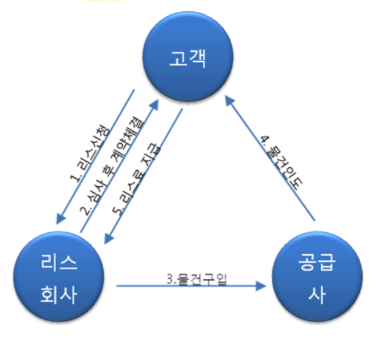
2. Lease flow
A typical lease transaction starts with the lessee's need to use an asset, and proceeds through the lessor's acquisition of the asset, delivery of the right to use it, and payment of lease payments.
About the diagram: The figure above is a simplified flow to aid understanding. Real transactions may involve other parties such as financial institutions and insurers.
3. Lessee accounting
K-IFRS 1116 (effective for annual periods beginning on or after January 1, 2019) applies a
single accounting model to lessees, with no distinction between finance and operating leases.
At commencement
The lessee recognizes a right-of-use asset and a lease liability on the balance sheet. The lease liability is measured at the present value of the lease payments not yet paid.
During the lease term
The right-of-use asset is depreciated and interest expense is recognized on the lease liability. Lease payments are treated as repayments of the lease liability.
Recognition exemptions
Short-term leases: leases with a lease term of 12 months or less and no purchase option
Leases of low-value underlying assets: leases where the underlying asset is of low value when new
When an exemption is applied, lease payments are expensed over the lease term on a straight-line or other systematic basis.
Note: Under the previous standard (K-IFRS 1017), operating leases were not recognized on the balance sheet and lease payments were simply expensed.
Under the current standard, they are recognized unless an exemption applies. Refer to the text of the standard for detailed measurement and disclosure requirements.
4. Lessor classification
Under the current standard, the lessor still classifies each lease as a finance lease or an operating lease.
Classification is based not on the contract's label but on the extent to which the risks and rewards incidental to ownership of the underlying asset are transferred,
and is made at the inception date (the earlier of the date of the lease agreement and the date of commitment to the principal terms).
Finance lease
A lease that transfers substantially all the risks and rewards incidental to ownership. The lessor recognizes a receivable for its net investment in the lease.
Operating lease
A lease that is not a finance lease. The lessor continues to recognize the underlying asset and recognizes lease payments as income.
Situations that may indicate a finance lease (examples)
The following are examples of situations that, individually or in combination, may lead to classification as a finance lease.
Transfer of ownership
Ownership of the underlying asset is transferred to the lessee by the end of the lease term
Purchase option
The lessee has an option to buy the asset at a price sufficiently below fair value, and at inception it is reasonably certain that the option will be exercised
Lease term
Even without a transfer of ownership, the lease term covers a major part of the economic life of the underlying asset
Recovery of fair value
At inception, the present value of the lease payments amounts to substantially all of the fair value of the underlying asset
Specialized assets
The underlying asset is so specialized that only the lessee can use it without major modifications
Important: Numeric thresholds such as 75% and 90% found in older training materials are not specified in K-IFRS 1116.
"Major part" and "substantially all" are judged by looking at the contract as a whole. Check the applicable standard and the contract terms for actual classification.
5. Lease modifications
The lessor classifies a lease at inception and does not reclassify it merely because of a change in estimates or circumstances.
However, a lease modification — a change in the scope of the lease or the consideration that was not part of the original terms — is assessed separately.
Original contract Classified at inception
→
Lease modification Assess whether a separate lease
→
After the modification Account by classification
Finance lease modification: If it is not accounted for as a separate lease, the treatment depends on whether the lease would have been an operating lease had the modification been in effect at inception. If so, it is accounted for as a new lease from the effective date of the modification, and the carrying amount of the underlying asset is measured as the net investment in the lease immediately before that date; otherwise, K-IFRS 1109 applies.
Operating lease modification: Accounted for as a new lease from the effective date of the modification.
Lessee: For a modification not accounted for as a separate lease, the lessee remeasures the lease liability and adjusts the right-of-use asset.
Note: Actual accounting may vary with the nature of the modification and the contract terms, so refer to the text of the standard.
6. Types of leases
The main lease types used in the Korean leasing industry, summarized by purpose and characteristics.
GENERAL LEASE
1. General lease
A contract in which a domestic leasing company and a lessee agree on lease payments over a set period, covering assets other than automobiles.
AUTO LEASE
2. Auto lease
Similar to a general lease, but the leased asset is limited to automobiles. Vehicle-related items such as automobile tax, environmental improvement charges, and fines can be managed.
FLEET LEASE / MAINTENANCE LEASE
3. MT lease
A maintenance lease for corporate customers with large vehicle fleets, providing management services from vehicle purchase through insurance, taxes, maintenance, and resale or disposal.
SALE & LEASEBACK
4. Sale and leaseback
The lessee sells an asset it owns to a leasing company and simultaneously leases the same asset back. It may be used as a way to raise funds.
SUBLEASE
5. Sublease
A transaction in which a leasing company leases onward to a third party an asset it has leased from another leasing company.
SYNDICATED LEASE
6. Syndicated lease
A contract structure in which several leasing companies participate jointly to spread risk and reduce each party's funding burden, used for large lease transactions.
CROSS-BORDER LEASE
7. Cross-border lease (export / overseas lease)
A lease across borders between a leasing company and a lessee of different nationalities. A typical example is a domestic leasing company acquiring an asset and leasing it to a foreign company.
LEVERAGED LEASE
8. Leveraged lease
A structure in which a lender such as an insurance company or pension fund participates in addition to the leasing company and the lessee. A substantial part of the funding is raised through assignment of lease payments and security over the asset.
Characteristics of a leveraged lease
Lenders provide funds based on rights to the lease payments and security over the leased asset.
The leasing company can take part in the transaction with relatively little of its own capital. Its investment share is generally described as around 20%.
Lease terms are typically 7 to 25 years, and aircraft and large plants are the main targets.
Terminology note: The terms and percentages above are general descriptions and do not apply to every transaction.